The last foragers, the first farmers
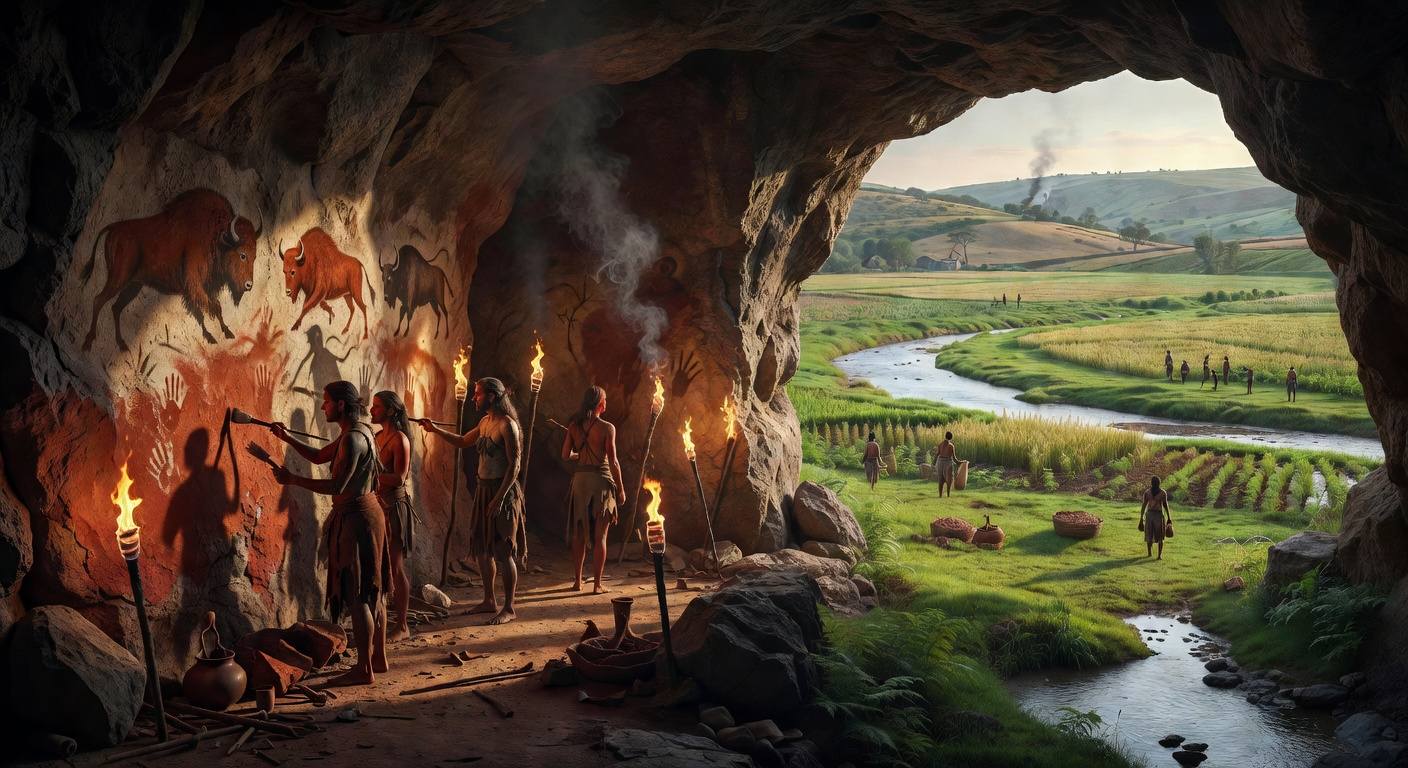
In the final chapter of the Stone Age, human creativity exploded. The caves of Europe filled with breathtaking paintings of horses, bison, and lions. Small ivory figurines of people and animals appeared across vast distances. Musical instruments were carved from bone. Burials became increasingly elaborate. These were not crude cavemen. They were people with fully modern minds living in a world that was still entirely wild.
The great turning
As the last ice age ended around 12,000 years ago, climates stabilized in many regions. In several independent centers — the Fertile Crescent, China, Mesoamerica, the Andes, and elsewhere — people began to experiment with planting the seeds of the plants they had previously gathered. Over generations, they selected for traits that made those plants more productive and easier to harvest. The same process happened with animals. Within a few thousand years, agriculture and pastoralism had transformed human societies on multiple continents.
The consequences were enormous. Populations grew. Permanent villages became towns and then cities. Social hierarchies deepened. Writing appeared. And for the first time, humans began to reshape landscapes on a scale visible from space.
The Neolithic Revolution was not a single invention but a slow, often reversible process that happened in different ways in different places. Once it took hold, however, it created a new kind of human relationship with the living world — one in which we no longer simply lived within Earth’s systems, but actively redesigned them.
- The famous Lascaux and Chauvet cave paintings were created by people who had no agriculture, no writing, and no metal tools — yet they produced art that still moves us today.
- Dogs were the first animals domesticated, probably more than 15,000 years ago, long before sheep, goats, or cattle.
- The earliest evidence of bread-making comes from a 14,000-year-old site in Jordan — thousands of years before full-scale agriculture.
- In the Americas, people independently domesticated maize, potatoes, tomatoes, and chocolate without any contact with Old World farmers.
- The transition to farming was not universally beneficial — many early agricultural populations show signs of worse health and more disease than their foraging ancestors.
- By 5,000 years ago, the foundations of the modern world — cities, writing, organized religion, and states — had already appeared in several regions.
The end of the wild world
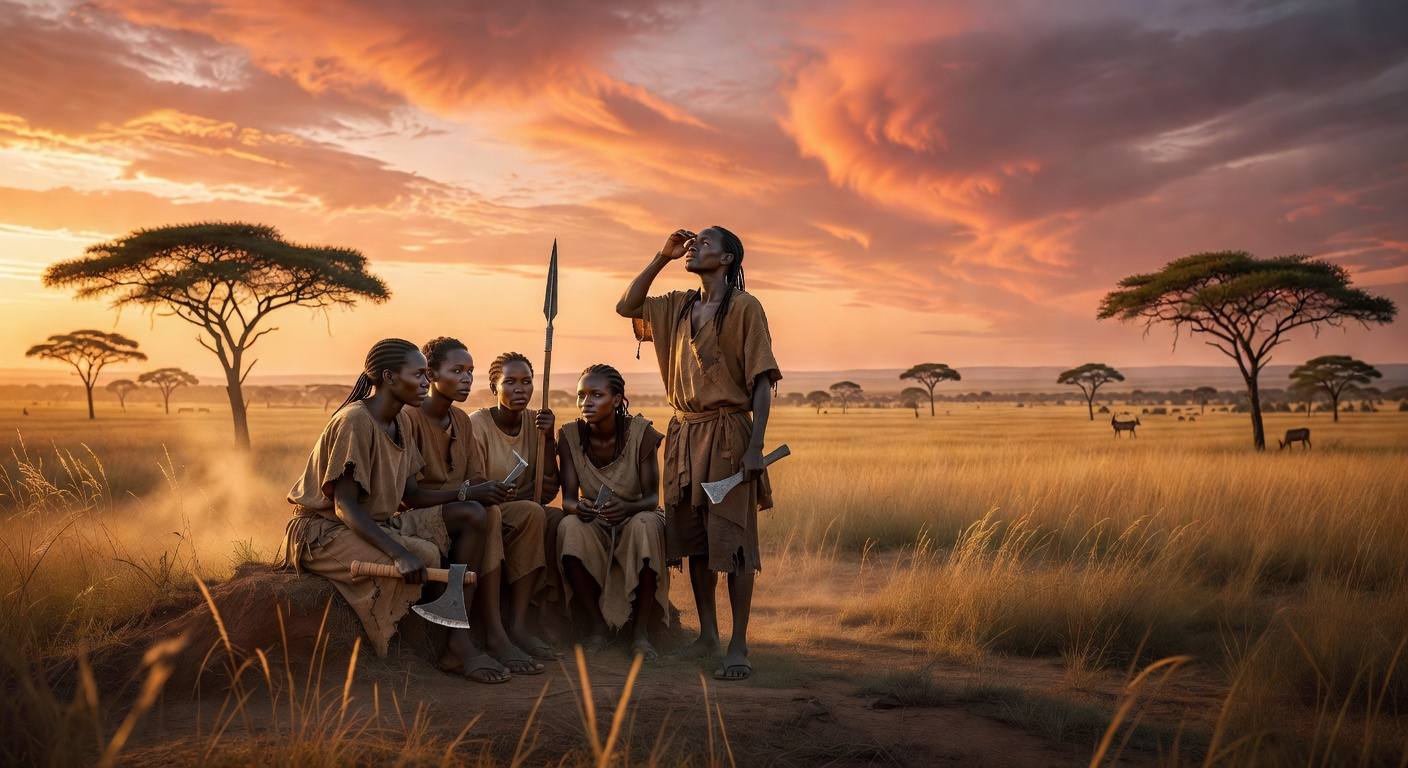
A reconstruction of the final millennia of the Stone Age — the rich artistic flowering of the Upper Paleolithic and the slow, revolutionary shift toward planting, herding, and permanent settlement.
Gallery
Timeline of the Final Stone Age
| Period | Development |
|---|---|
| 50,000–30,000 ya | Upper Paleolithic flowering |
| ~12,000 ya | End of the last ice age |
| ~10,000–8,000 ya | First farming villages |
| ~5,500 ya | First cities and writing |
Why this turning matters
For 13.8 billion years, Earth’s living systems had operated without a single species deliberately redesigning them at global scale. The Neolithic Revolution marked the beginning of that new reality — and we are still living inside its consequences.
Hunter-gatherers lived inside the rhythms of the living world. Farmers and city-builders began to impose their own rhythms on it. That shift in relationship is the deepest change in the entire Cenozoic Dawn.
In the Gaia Odyssey, this is the moment the narrator gains the ability to edit the plot. What we do with that power in the next few centuries will determine whether the story remains one of increasing complexity or enters a new period of simplification.
We are still in the first moments of the human epoch.
The entire agricultural and industrial transformation of the planet has taken place in less than 0.0001% of Earth’s history. We are the youngest chapter in the Gaia Odyssey — and the only one with the capacity to decide what the next chapters will contain.
Sources & Further Reading
Frequently Asked Questions
Why did people start farming if hunting and gathering was often healthier?↓
It was not a conscious global decision. In many places it was a gradual response to population pressure, climate stability after the ice age, and the simple fact that once people began tending plants and animals, those practices slowly became hard to abandon as populations grew.
Was the Upper Paleolithic really as creative as it seems?↓
The evidence suggests yes. The art, music, and symbolic objects from this period show the same cognitive capacities we associate with fully modern humans. These were people who thought and felt in ways we would recognize.
How much of today’s world is still shaped by Stone Age decisions?↓
Far more than we usually realize. Our bodies, our social instincts, our tendency to form tribes, and even many of our cognitive biases were shaped during the long Stone Age. Agriculture and civilization are very recent overlays on a much older psychology.
What does the end of the Stone Age mean for the Gaia Odyssey?↓
It marks the moment when one species began to write the next chapters of Earth’s story with intention. Whether those chapters will be a continuation of the long increase in complexity or a sharp break remains the central question of our time.