Standing on two feet
Sometime between 7 and 6 million years ago, in the woodlands and grasslands of East and Central Africa, a small population of apes began to spend more time on the ground and less time in the trees. Over generations, their skeletons changed. The pelvis became shorter and bowl-shaped. The big toe moved in line with the other toes. The spine developed the curves that allow an upright body to balance over the hips and legs.
Small brains, big commitment
These early hominins — the group that includes Australopithecus and its relatives — were still very much ape-like in their brains and faces. Their skulls held brains no larger than those of modern chimpanzees. Their teeth and jaws were built for a mixed diet of fruits, leaves, and tough roots. What made them different was posture. They could walk long distances on two legs while carrying food, tools, or infants in their arms.
The famous skeleton known as Lucy, an Australopithecus afarensis who lived about 3.2 million years ago, stood roughly a meter tall and weighed around 29 kilograms. She walked upright, but she could probably still climb trees efficiently. Her species and others like it survived for over a million years in a changing African landscape.
Bipedalism was not an obvious improvement. It made birth more dangerous, made the spine more vulnerable to injury, and slowed running speed compared with four-legged apes. Yet it persisted. The advantages in carrying, seeing over tall grass, and freeing the hands must have outweighed the costs for hundreds of thousands of generations.
- “Lucy” was named after the Beatles song “Lucy in the Sky with Diamonds,” which was playing at the celebration after her discovery.
- Early hominins had brains only slightly larger than chimpanzees, yet they walked upright for over 3 million years before brain size began to increase dramatically.
- The famous “Laetoli footprints” in Tanzania, made 3.6 million years ago, show two adults and a child walking upright across wet volcanic ash.
- Some early hominins lived alongside other species of hominins for long periods — multiple “experiments” in being human-like existed at the same time.
- Their diet was probably highly varied, including roots, tubers, and occasional meat scavenged from predator kills.
- Standing upright exposed more of the body to the sun, which may have driven the evolution of reduced body hair and increased sweating in later hominins.
The first walkers on the savanna
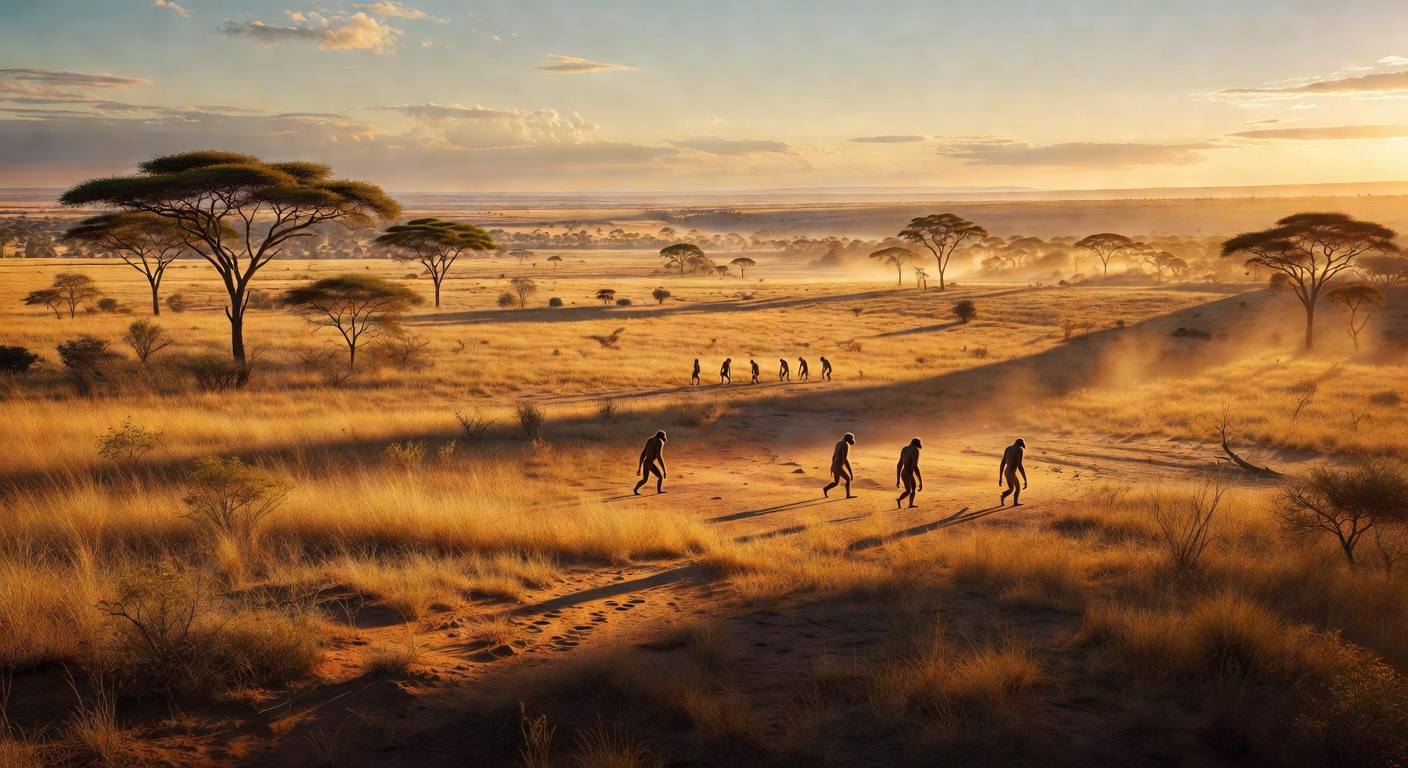
A reconstruction of Australopithecus groups moving across the mosaic landscapes of Pliocene Africa, still able to climb but increasingly committed to life on the ground.
Gallery


Timeline of the First Upright Walkers
| Time | Species / Event |
|---|---|
| ~7–6 mya | First hominins appear |
| ~4–3 mya | Australopithecus radiates |
| ~3.2 mya | “Lucy” (A. afarensis) |
| ~2.5–2 mya | First stone tools appear |
Why these first steps matter
Bipedalism is mechanically awkward and obstetrically dangerous. That it became fixed in the hominin line tells us the advantages — carrying, long-distance travel, and seeing over vegetation — were powerful enough to reshape an entire body plan.
For more than two million years, hominins walked upright with brains the size of chimpanzees. The physical commitment to terrestrial life came first. The explosion in brain size that defines our genus came later, building on that foundation.
Every human alive today carries the legacy of these small, determined walkers who lived and died on one continent for millions of years. The entire later story of human dispersal begins with their quiet persistence.
The first true wanderers with bigger brains and stone tools.
Around 2 million years ago, a new kind of hominin emerged in Africa — taller, with a significantly larger brain, and the ability to make and carry stone tools. This was Homo erectus, and it would be the first member of our lineage to leave the continent.
Sources & Further Reading
Frequently Asked Questions
Were early hominins like Lucy really our direct ancestors?↓
Not in a simple straight line. Australopithecus afarensis is very close to the lineage that eventually produced Homo, but there were multiple hominin species living at the same time. Lucy’s species is one of our closest known relatives from that era.
Why would apes start walking on two legs when four legs are faster?↓
The most likely reasons involve freeing the hands for carrying food and infants, being able to see over tall grass, and traveling efficiently between scattered food sources in a changing landscape. Speed was less important than endurance and versatility.
Did these early hominins use tools?↓
Simple stone tools appear around 2.6 million years ago, near the end of the australopith era and the beginning of the Homo line. Earlier hominins probably used unmodified sticks and stones, but they did not yet shape them systematically.
How does the story of early hominins fit the Gaia Odyssey?↓
It shows how a small, local population on one continent, responding to ordinary environmental pressures, made a physical commitment that would eventually allow a single species to understand the entire 13.8-billion-year history of the universe.