The clever branch
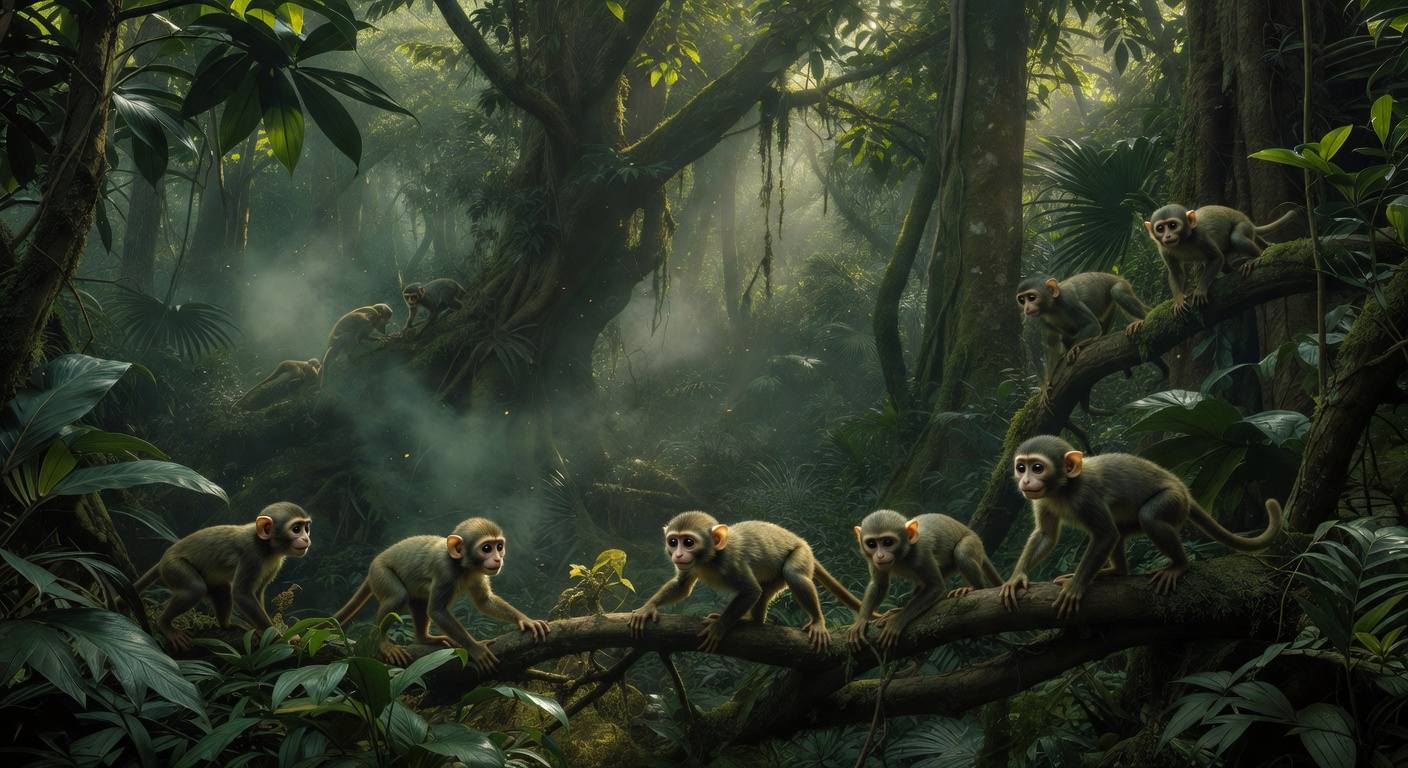
Not long after the last dinosaurs disappeared, a small group of mammals began to make their living high in the trees. They had forward-facing eyes that gave them true depth perception, hands that could grasp branches, and brains that were already slightly larger than those of most other mammals their size. These were the first primates.
A slow accumulation of advantages
For tens of millions of years, primates remained mostly small and tree-dwelling. But the traits that made them good at life in the canopy — excellent vision, precise hand control, and the ability to learn from one another — also happened to be the raw materials for something much rarer. Over time, some lineages grew larger. Some became more social. And in a few, the brain began to expand dramatically relative to body size.
By the time the climate cooled and African forests gave way to more open woodlands, one branch of these primates had already developed the skeletal foundations for upright walking. They were still small-brained and ape-like in many ways, but the stage was set for an unprecedented experiment in intelligence.
The primate path was not aimed at humans. It was a long series of small improvements in seeing, grasping, and cooperating that happened to create the conditions for a brain capable of language, art, and science billions of years after the Earth first formed.
- Primates were among the first mammals to develop true color vision, a rare trait among mammals.
- The human brain is roughly three times larger, relative to body size, than that of our closest living relatives.
- Early primates already showed the ability to use simple tools and pass knowledge across generations.
- Most primate species that ever lived are now extinct. We are one of the few surviving branches.
- The split between the human line and the chimpanzee line occurred only about 6–7 million years ago — a blink in deep time.
- No other group of mammals has produced a species capable of asking where it came from.
The tree-dwelling ancestors of thought
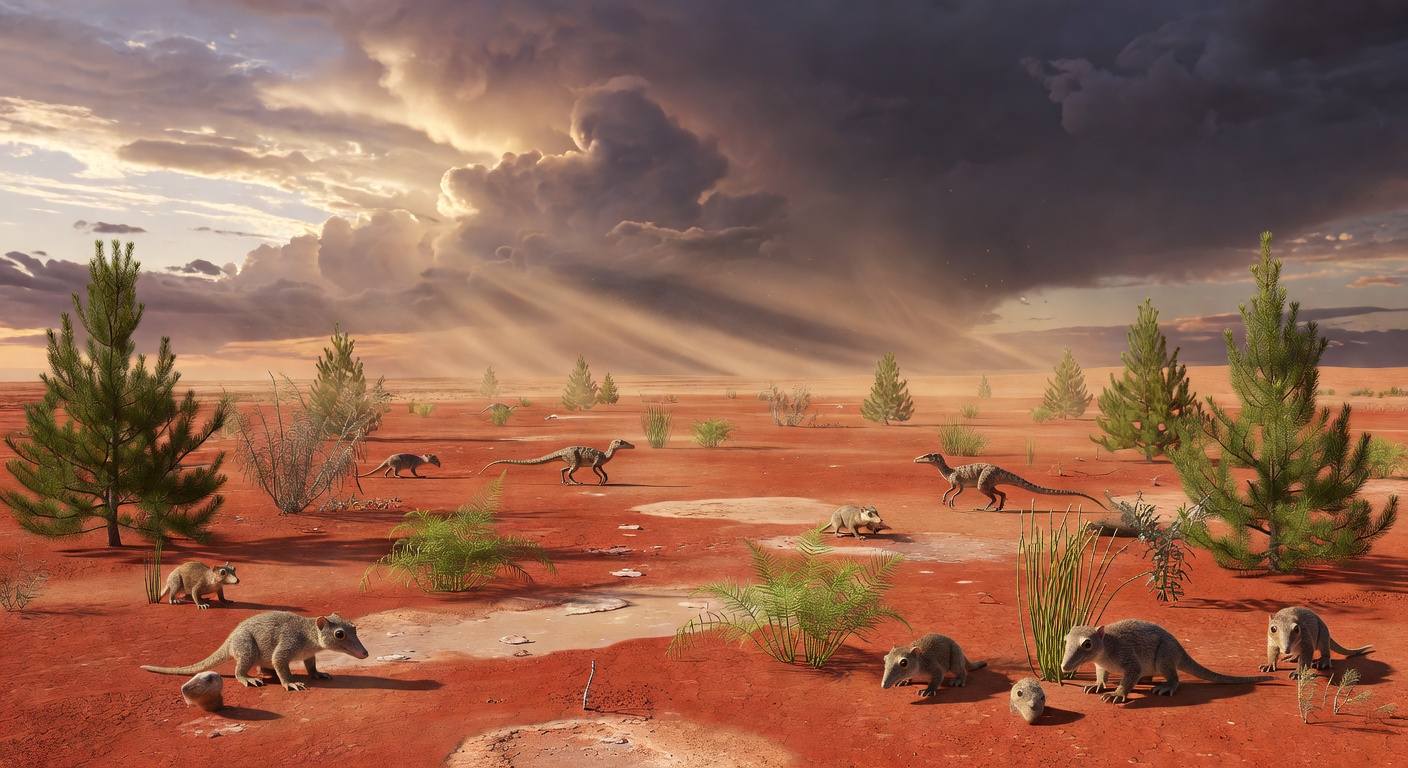
A reconstruction of early primate life in the canopy and the gradual shift toward more open environments that would eventually favor bipedal locomotion.
Gallery
Timeline of the Primate Journey
| Time | Development |
|---|---|
| 65–40 mya | Early primates emerge |
| 40–20 mya | Brain expansion begins |
| 20–7 mya | Apes diversify |
| 7–6 mya | The human line splits |
Why this path matters
Depth perception, grasping hands, and a tendency toward social learning are not obviously useful for building civilizations. Yet together they created the substrate for everything that would follow — language, technology, and the capacity to ask where we came from.
In the Gaia story, the primate brain is one of the most striking examples of life developing the ability to model its own environment and, eventually, the entire cosmos. This capacity emerged from the same evolutionary processes that produced trilobites and dinosaurs.
The same hands that once gripped branches now hold telescopes and write equations. The social instincts shaped in small groups now scale to billions. Understanding the primate path is understanding the deep roots of our own minds.
The first ones to stand up and look around.
Around 6–7 million years ago, in the forests and woodlands of Africa, a small group of primates began walking on two legs. They were still small-brained and largely ape-like, but they had taken the first step onto a path that would change everything.
Sources & Further Reading
Frequently Asked Questions
Why did primates evolve forward-facing eyes and grasping hands?↓
These traits are highly useful for judging distances and gripping thin branches in a complex three-dimensional environment. Once present, they also turned out to be excellent foundations for tool use and eventually technology.
How much of human intelligence is really just primate intelligence?↓
A surprising amount. Our core social abilities, our capacity for learning through imitation, and even our tendency to form large cooperative groups all have deep roots in primate evolution. The human brain is an elaboration, not a complete reinvention.
Did primates always live in trees?↓
Most early primates were arboreal, but many later groups became partially or fully terrestrial. The human lineage is one of several that eventually left the trees behind almost completely.
Why is the primate story so central to the Gaia Odyssey?↓
Because it is the chapter in which Earth, through ordinary evolutionary processes, produced a form of life capable of understanding the entire 13.8-billion-year journey that preceded it — including its own place within that story.