The long stride
Around two million years ago, a new kind of hominin appeared in East Africa. Taller than its predecessors, with longer legs built for efficient long-distance walking and a brain already significantly larger than that of Australopithecus, this species would become the most successful and widespread member of our genus until the arrival of our own. We call it Homo erectus.
Fire, tools, and travel
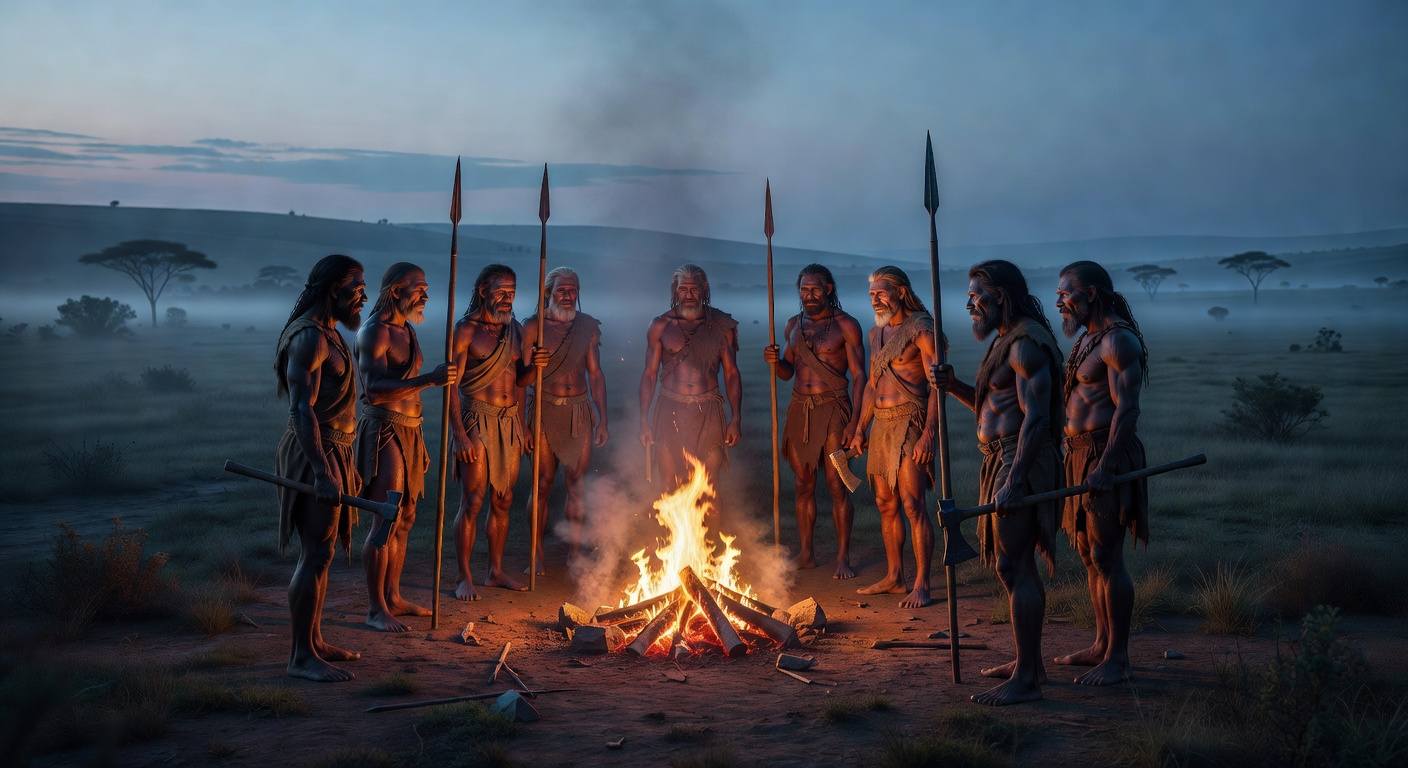
Homo erectus made the first large, symmetrical stone tools — the famous Acheulean handaxes that required planning and skill. More importantly, they appear to have been the first to routinely control fire. Cooking food allowed more calories to be extracted from meat and plants, supporting larger brains and smaller guts. With fire they could stay warm at night, deter predators, and eventually move into colder latitudes.
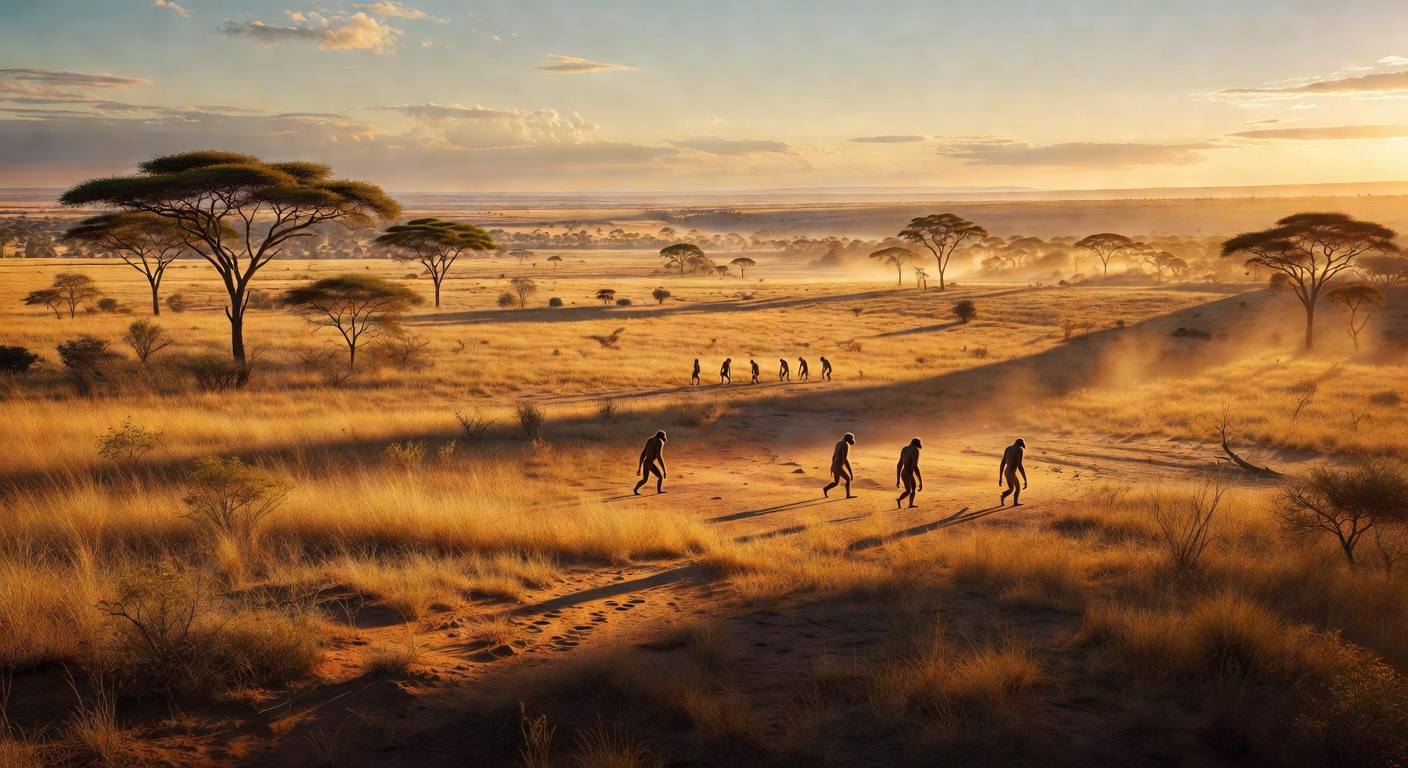
By 1.8 million years ago, populations of Homo erectus had already reached what is now Georgia in the Caucasus. Within a few hundred thousand years they were in Java. They were the first hominins to live in environments as different as tropical rainforests and temperate woodlands. They did this not by changing their bodies dramatically, but by carrying culture — tools, fire, and knowledge — with them.
Homo erectus was not a brief transitional stage. It endured for nearly two million years — far longer than our own species has existed so far. Its success came from a combination of physical endurance, technological skill, and the ability to pass knowledge across generations in many different environments.
- Homo erectus was the first hominin to have a body proportion very similar to our own — long legs, short arms, and an efficient striding gait.
- The oldest known hominin fossils outside Africa are 1.8-million-year-old Homo erectus remains from Dmanisi, Georgia.
- Some populations of Homo erectus may have survived on the island of Java until as recently as 100,000 years ago.
- They were the first to produce tools that required a mental template — the same basic handaxe shape appears across thousands of kilometers and hundreds of thousands of years.
- Cooking with fire dramatically increased the energy available to their brains and allowed them to eat a wider range of foods.
- Their skulls were thick-walled and had prominent brow ridges, giving them a very different appearance from later Homo species.
The first humans across continents
A reconstruction of Homo erectus groups moving through diverse landscapes, carrying fire, tools, and the accumulated knowledge that allowed them to thrive far from their African origins.
Gallery

Timeline of the First Global Hominin
| Time | Milestone |
|---|---|
| ~2.0–1.8 mya | Homo erectus appears in Africa |
| ~1.8 mya | First exit from Africa |
| ~1.6–1.0 mya | Spread across Asia |
| ~400–110 kya | Last known populations |
Why Homo erectus matters
More than any previous hominin, Homo erectus relied on learned behavior — tool designs, fire management, hunting strategies — that could be carried across landscapes and taught to the next generation. Culture became a survival tool as important as teeth or claws.
They were not the smartest or the strongest hominins that ever lived. Their success came from being good enough at many things across many environments for an extraordinarily long time. Sometimes persistence matters more than rapid change.
Every later movement of humans out of Africa — including our own species — follows the pattern first established by Homo erectus. They proved that a relatively small-brained primate could thrive across continents if it could carry fire and knowledge.
Our closest extinct relatives — powerful, intelligent, and strangely familiar.
While Homo erectus still walked parts of Asia, a new branch of hominins was evolving in Europe and the Middle East. They were stockier, had larger brains than erectus, and would become the Neanderthals — the species we now know interbred with our own ancestors.
Sources & Further Reading
Frequently Asked Questions
How did Homo erectus survive in so many different climates?↓
A combination of physical toughness, the ability to make warm clothing from hides, and especially the control of fire allowed them to stay warm and cook food in places where earlier hominins could not have survived.
Did Homo erectus speak or have language?↓
We cannot know for certain. Their brain size and the complexity of their tools suggest they had more sophisticated communication than earlier hominins, but whether they had anything like modern language remains one of the great open questions in paleoanthropology.
Why did Homo erectus eventually disappear?↓
They were gradually replaced or absorbed by later species with larger brains and more sophisticated technology. In some places they may have persisted for a very long time in isolation before finally vanishing.
What makes Homo erectus so important in the Gaia story?↓
They proved that a primate species could carry its survival technology across entire continents and thrive in environments radically different from the ones in which it first evolved. That capacity for cultural adaptation is the thread that runs through all later human success.