The species that looks back
Anatomically modern humans — people who would look like us if dressed in modern clothes — first appear in the fossil record of Africa around 300,000 years ago. For most of the next 200,000 years, their material culture remained relatively simple. Then, beginning roughly 70,000 years ago, something changed. Art appears. Long-distance trade networks emerge. Tools become more varied and inventive. People begin to bury their dead with clear symbolic rituals.
The great dispersal
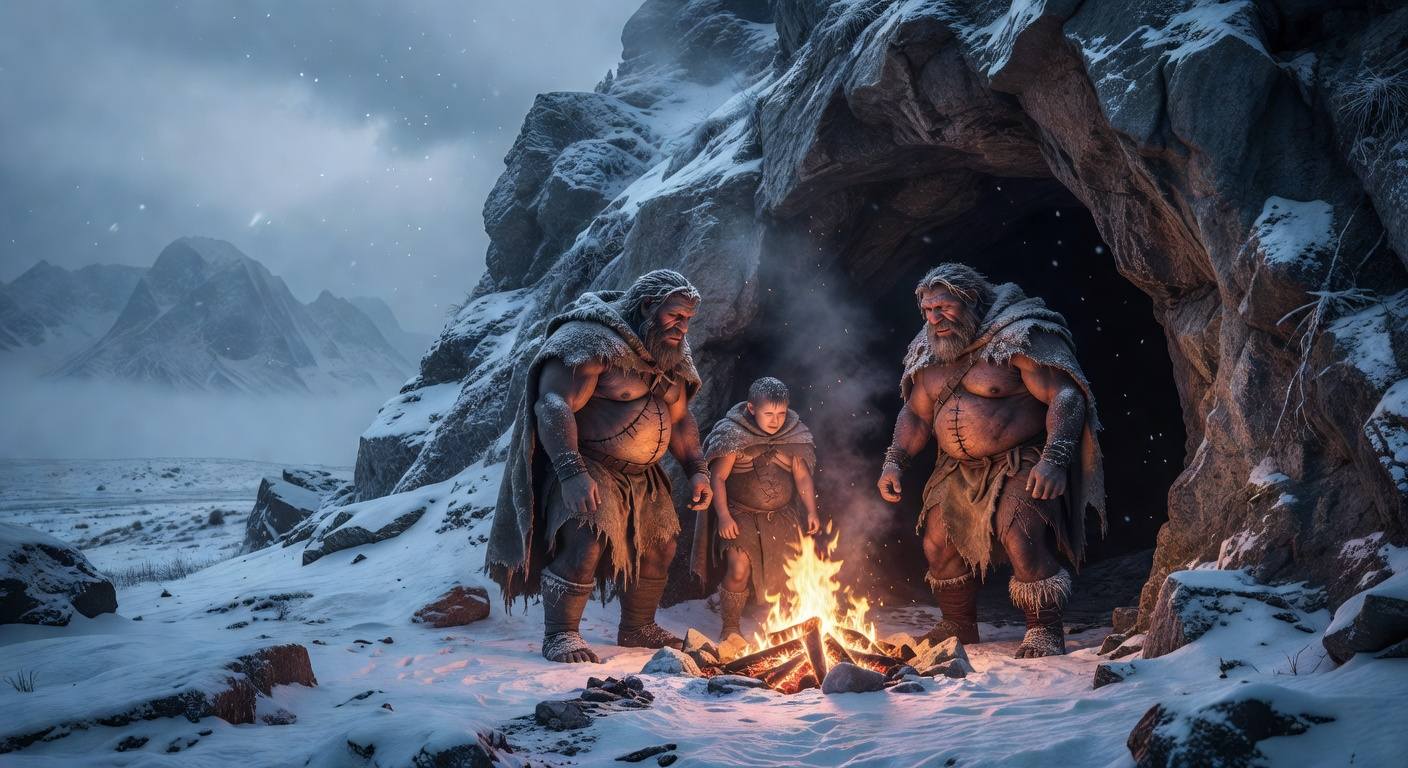
Between 70,000 and 50,000 years ago, groups of these behaviorally modern humans began moving out of Africa in significant numbers. They entered the Middle East, then Asia, Australia, and eventually Europe — where they encountered and mixed with Neanderthals. By 15,000 years ago they had reached the Americas. In less than 60,000 years, one primate species had walked, paddled, and adapted its way across almost the entire habitable surface of the planet.
Wherever they went, they carried an unusual capacity: the ability to imagine things that do not yet exist, to tell stories about the past and future, and to cooperate in large groups bound by shared beliefs rather than kinship alone.
Homo sapiens is not simply the smartest animal. We are the only species that can construct shared realities — money, nations, religions, science — and then act collectively on those fictions. That capacity, more than any individual cleverness, is what allowed one small African lineage to reshape the entire biosphere in a geological instant.
- All humans alive today descend from a relatively small population that lived in Africa roughly 200,000–300,000 years ago.
- The famous cave paintings at Chauvet and Lascaux were made by people who were genetically and cognitively indistinguishable from us.
- Humans reached Australia at least 50,000 years ago — one of the earliest long-distance sea crossings in our history.
- We are the only primate species that has ever occupied every major landmass on Earth (except Antarctica until very recently).
- The “Out of Africa” migrations were not a single event but repeated waves over tens of thousands of years.
- Every human language, no matter how different it sounds, shares deep structural features that point to a common origin in Africa.
The species that would tell the whole story
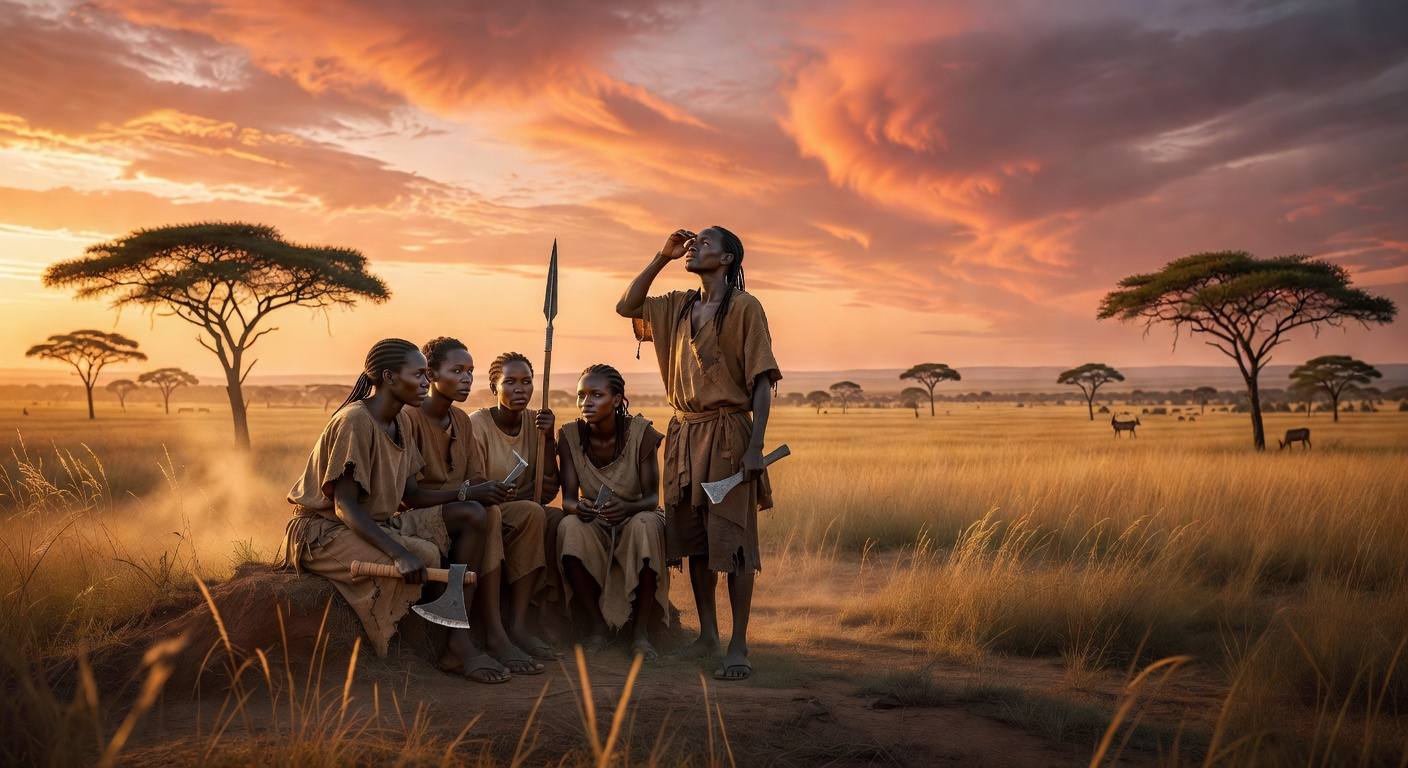
A reconstruction of early Homo sapiens groups in Africa and the first waves of people carrying symbolic culture and long-distance planning out into the wider world.
Gallery
Timeline of the Human Dawn
| Time | Development |
|---|---|
| ~300 kya | Anatomically modern humans appear |
| ~100–70 kya | Behavioral modernity emerges |
| ~70–50 kya | Major dispersals begin |
| ~15–12 kya | Last major continents reached |
Why this arrival matters
For the first time in 13.8 billion years, a species emerged that could construct a reasonably accurate model of the entire history that produced it — from the Big Bang through the formation of galaxies, stars, planets, and life itself.
No other single species has ever altered the chemistry of the atmosphere, the composition of the oceans, and the distribution of life across the planet as rapidly as Homo sapiens has in the last 12,000 years. We are a new kind of geological agent.
In the Gaia Odyssey, this is the chapter where the story gains a narrator. Whether that narrator becomes a wise steward or a shortsighted destroyer remains the open question that will define the next chapters of Earth’s long history.
The last 12,000 years that changed everything.
After the great ice sheets began to retreat, one branch of Homo sapiens took the most consequential step since walking upright: they began deliberately planting seeds, taming animals, and settling in permanent villages. The Stone Age was ending, and the human epoch was about to begin.
Sources & Further Reading
Frequently Asked Questions
If modern humans appeared 300,000 years ago, why did “civilization” only start 12,000 years ago?↓
Anatomical modernity came first. The full package of symbolic thinking, complex planning, and cumulative culture that we call behavioral modernity developed later and spread unevenly. For most of our species’ existence we lived in small, mobile groups with rich oral traditions but without agriculture or cities.
Are we still evolving?↓
Yes. Human populations continue to experience natural selection on traits related to disease resistance, altitude adaptation, diet, and even some cognitive and behavioral tendencies. Culture has changed the selection pressures, but it has not removed them.
How did such a small African population come to dominate the entire planet?↓
A combination of high adaptability, cumulative culture that allowed rapid innovation, and the good fortune of living during a period of major climate instability that rewarded flexibility over specialization. Once the great dispersals began, there was no turning back.
What does it mean that we are the only surviving hominin?↓
It means we carry an enormous responsibility. For the first time in the Gaia Odyssey, a single species has the power to determine the fate of countless other forms of life — and to decide whether the story of Earth continues to be one of increasing complexity or one of simplification and loss.