The moment everything began
In the first 10⁻⁴³ seconds of existence — a time known as the Planck epoch — the universe was infinitely dense and hot. Space and time as we understand them did not yet exist in any familiar form. All four fundamental forces were unified. Then, in an instant, the universe began to expand and cool, and the laws of physics we know today started to take shape.
The First Fractions of a Second
Within the first second, quarks and gluons formed the first protons and neutrons. By three minutes, the first atomic nuclei had formed in a process called Big Bang nucleosynthesis. For the next 380,000 years the universe remained a hot, opaque plasma of electrons and nuclei. Light could not travel freely.
Recombination and the First Light
Then came recombination. The universe cooled enough for electrons to bind with nuclei, forming the first neutral atoms. In that moment, the universe became transparent. The light released during this transition has been traveling through space ever since. We detect it today as the Cosmic Microwave Background — the oldest light in the universe.
The Big Bang was not an explosion *in* space — it was the expansion *of* space itself. Every point in the universe was once the center. There is no edge and no center to the Big Bang.
- In the first 10⁻³⁶ seconds, the universe underwent a period of exponential expansion called cosmic inflation, growing larger than the observable universe in a fraction of a second.
- The entire observable universe today was once smaller than a single atom.
- The Cosmic Microwave Background is the afterglow of the Big Bang and has been traveling for 13.8 billion years.
- Only hydrogen, helium, and tiny amounts of lithium were created in the Big Bang. All heavier elements were forged later inside stars.
- We have measured the temperature of the early universe to extraordinary precision using the Planck satellite.
- The Big Bang theory is supported by three major pillars: the expansion of the universe, the abundance of light elements, and the Cosmic Microwave Background.
Timeline of the First Moments
| Time After Big Bang | Event |
|---|---|
| 0 – 10⁻⁴³ s | Planck Epoch |
| 10⁻³⁶ – 10⁻³² s | Cosmic Inflation |
| ~1 second | Quark-Gluon Plasma |
| ~3 minutes | Big Bang Nucleosynthesis |
| ~380,000 years | Recombination |
This timeline represents the current scientific consensus based on observations from the Planck satellite and other missions.
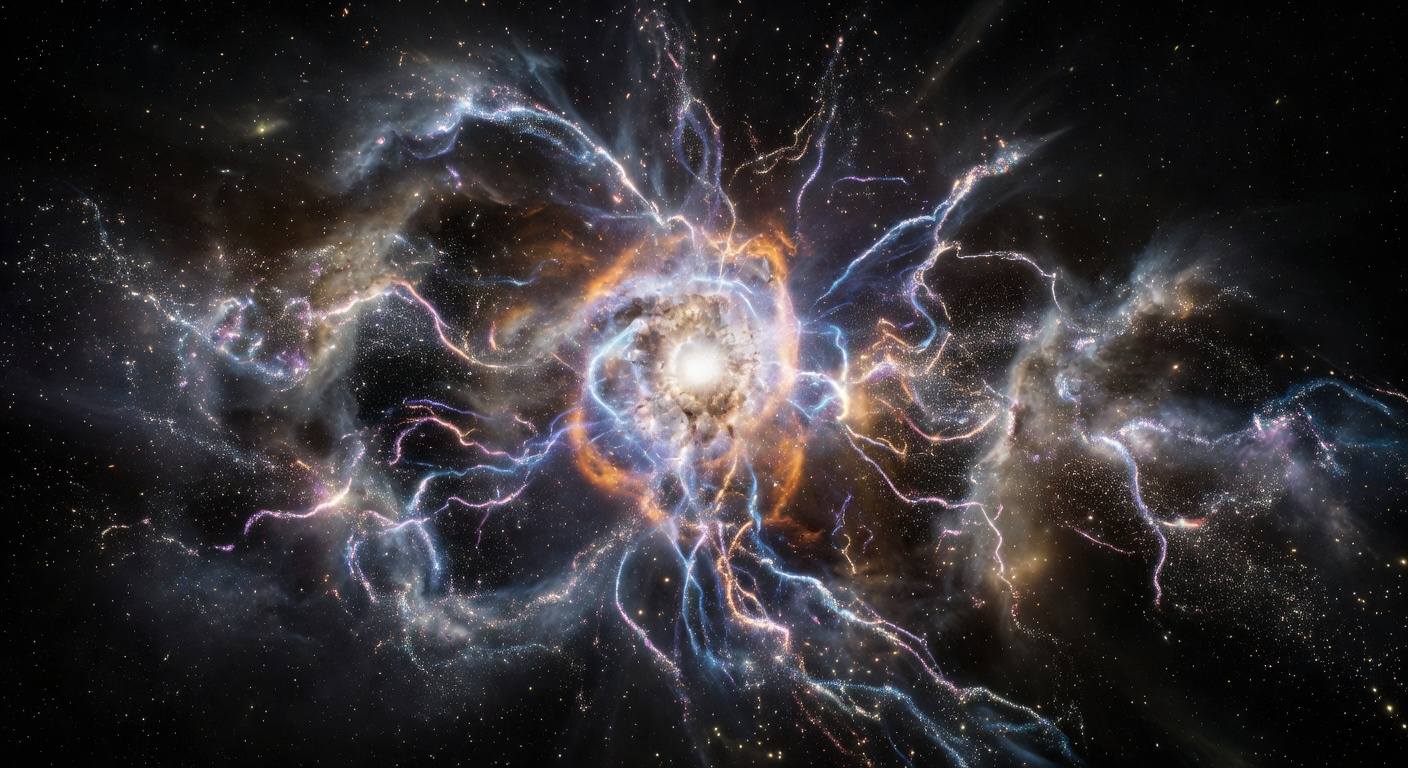
From singularity to the first light
A scientifically grounded reconstruction of the first moments — the Planck epoch, rapid inflation, and the release of the Cosmic Microwave Background 380,000 years later.
Gallery
Why the Big Bang Matters
Every atom of hydrogen in your body, every trace of helium in the Sun, and the very fabric of space itself traces directly back to this single event. The Big Bang is not just the beginning of the universe — it is the beginning of you. Understanding it reveals that we are not separate from the cosmos; we are its direct continuation.
The quantum fluctuations that occurred in the first second grew, over billions of years, into galaxies, stars, planets, and eventually life. The story of the Gaia Odyssey begins here.
Frequently Asked Questions
Was the Big Bang an explosion?
No. The Big Bang was not an explosion *in* space. It was the rapid expansion *of* space itself from an extremely hot, dense state. There was no center and no edge.
What existed before the Big Bang?
Time itself began at the Big Bang. The question "what came before" may not be meaningful in the way we normally think about it. Some theories propose a prior contracting phase, but we have no direct evidence.
How do we know the Big Bang happened?
Three independent lines of evidence: the observed expansion of the universe (Hubble's law), the precise ratios of hydrogen and helium predicted by theory, and the Cosmic Microwave Background radiation discovered in 1965.
Did the Big Bang create life?
Indirectly. The Big Bang created the hydrogen and helium that later formed the first stars. Those stars created the heavier elements (carbon, oxygen, iron) that eventually became planets and living organisms. We are made of stardust that began its journey at the Big Bang.